Humanity's First Crewed Return to Deep Space Since 1972: Understanding What Artemis II Seeks to Achieve
NASA's Artemis II mission launches humans beyond low Earth orbit for the first time since 1972. Four astronauts aboard Orion will fly a free-return trajectory around the Moon, testing systems for future lunar landings and Mars exploration.
By Fwamba Nc Fwamba
1st April,2026
Tonight, NASA is launching Artemis II aboard the Orion spacecraft, propelled by the Space Launch System. This is the most powerful rocket ever constructed, generating approximately thirty-nine million newtons of thrust, a force equivalent to about four million kilograms at liftoff. That power is not an end in itself. It is the mechanism through which humanity resumes a journey interrupted for more than half a century.
The last time human beings traveled beyond low Earth orbit was in December 1972 during Apollo 17. That mission marked the conclusion of the Apollo Program, which had begun with Apollo 8 orbiting the Moon in 1968 and reached its defining moment with Apollo 11 in July 1969. After 1972, human spaceflight contracted inward, focusing on low Earth orbit through programs such as the Space Shuttle era from 1981 to 2011 and the continuous habitation of the International Space Station since November 2000.
This long orbital phase was not stagnant. It was preparation. It allowed humanity to learn how to live in space for extended periods, to manage life support systems, and to cooperate across nations in a sustained technological environment. Yet it also marked a limitation. Humanity had learned how to remain near Earth, but not how to extend itself beyond.
The Artemis program emerges from that accumulated knowledge. Its first decisive step came with Artemis I, launched in November 2022. That mission sent Orion around the Moon and back, testing deep space navigation, propulsion, and re-entry at velocities approaching 40,000 kilometers per hour. Artemis I established that modern systems, developed decades after Apollo, could endure the same extreme conditions.
Artemis II now advances that proof into the human domain. Scheduled as the first crewed Artemis mission, it represents the reintroduction of human presence into deep space for the first time since 1972. It is designed as a mission of approximately ten days, during which the crew will travel a trajectory extending over four hundred thousand kilometers from Earth, moving beyond any distance previously reached by human beings.
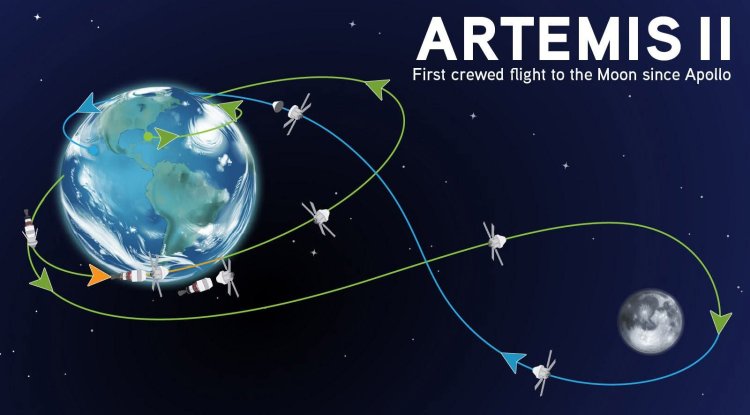
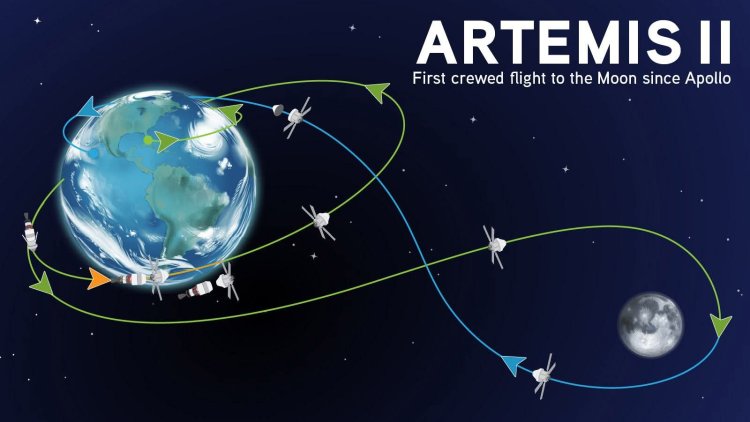
The path Artemis II follows is both precise and conceptually accessible. After launch, Orion is placed into an initial Earth orbit, where systems are verified. This phase is essential because it ensures that all critical functions are operational before committing to departure. The mission then proceeds to trans lunar injection, a controlled burn that accelerates the spacecraft beyond Earth’s gravitational dominance and sets it on a course toward the Moon.
Once this burn is complete, the spacecraft enters a coasting phase. It travels without continuous propulsion, guided by the velocity imparted during injection and the gravitational interaction between Earth and the Moon. As distance increases, the crew experiences a growing separation from Earth, both physically and operationally.
Upon reaching the Moon, Orion does not enter a sustained orbit. Instead, it follows a free return trajectory, a path first used during Apollo 8 in December 1968. This trajectory allows the spacecraft to swing around the Moon and be redirected toward Earth purely through gravitational forces. It is a design that prioritizes safety, ensuring that the mission can return even with limited propulsion.
At the far side of the Moon, the crew will reach a maximum distance exceeding that achieved during the Apollo missions. This moment represents not only a spatial milestone but a restoration of capability lost after 1972.
The return phase follows naturally from this trajectory. Earth’s gravity draws the spacecraft back, accelerating it to high velocities before atmospheric re-entry. Orion’s heat shield, tested during Artemis I in 2022, will again be subjected to extreme temperatures as it protects the crew during descent. The mission concludes with a splashdown in the ocean, completing a full gravitational pull.
The crew of Artemis II reflects the continuity of human spaceflight experience. Reid Wiseman, Victor Glover, Christina Koch, and Jeremy Hansen bring with them extensive experience derived largely from missions aboard the International Space Station between 2000 and the present. Their training and prior missions reflect a transition from short-duration exploration to sustained habitation, a shift that is essential for future deep space missions.
Artemis II also exists within a broader technological and strategic framework that extends beyond NASA. One of the most significant developments in this context is Starship, first tested in the early 2020s and designed for full reusability and large-scale cargo transport. Within the Artemis program, Starship is intended to function as a lunar lander in future missions, beginning with Artemis III, currently projected later in the decade. This reflects a structural evolution in space exploration, where multiple systems perform specialized roles within a coordinated architecture.
The Moon itself is being redefined within this framework. Rather than serving solely as a symbolic destination, it is being positioned as a site of sustained activity. Scientific data gathered over recent decades indicate the presence of water ice in permanently shadowed lunar regions. This resource can be processed into hydrogen and oxygen, enabling the production of rocket fuel. Such capability transforms the Moon into a potential refueling station, reducing dependence on Earth for deep space missions.
This shift is critical for the long-term objective of reaching Mars, a goal actively discussed in space policy and planning through the 2020s and projected into the 2030s. Mars missions will require extended-duration travel, exposure to deep-space radiation, and a level of autonomy far beyond current orbital operations. These conditions cannot be fully simulated in low Earth orbit. They require an intermediate stage.
The Moon provides that stage.
Through Artemis, humanity begins to construct the knowledge, infrastructure, and operational experience necessary for missions beyond the Earth-Moon system. The progression is deliberate. From Artemis I in 2022 to Artemis II in the mid 2020s, followed by planned lunar landings and sustained presence later in the decade, each step builds upon the last.
Artemis II, therefore, occupies a precise position in history. It follows the last human journey to deep space in 1972. It builds upon the uncrewed validation of 2022. It prepares for sustained lunar activity expected before the end of the 2020s. And it contributes to the long-term objective of human missions to Mars in the decades that follow.
What Artemis II seeks to achieve is not limited to the success of a single mission. It seeks to restore continuity in human exploration. It demonstrates that the technological, scientific, and operational lessons of the past fifty years can be extended beyond Earth orbit. It confirms that deep space is no longer an exceptional destination visited briefly, but an environment that can be entered, studied, and eventually inhabited.
In this sense, Artemis II is not a beginning defined by novelty. It is a continuation defined by intention, anchored in history, and directed towards a future that extends beyond the immediate horizon of Earth.
What's Your Reaction?