Why We Shall Never Die
Everything that lives, breathes, grows and decays carries within it the memory of the universe. From the smallest bacterium to the grandest galaxy, existence is written in one timeless language known as Deoxyribonucleic acid, DNA. The same atoms that once blazed in the hearts of ancient stars now flow through our blood, whisper in our breath and rise again in the veins of trees. Our beginning was not in a cradle or a garden but in the nuclear furnaces of stars that died long ago. Every element heavier than hydrogen was born in the explosions of supernovae, cosmic events so fierce that they filled the universe with the carbon, nitrogen, oxygen and iron that now compose every cell of our bodies.
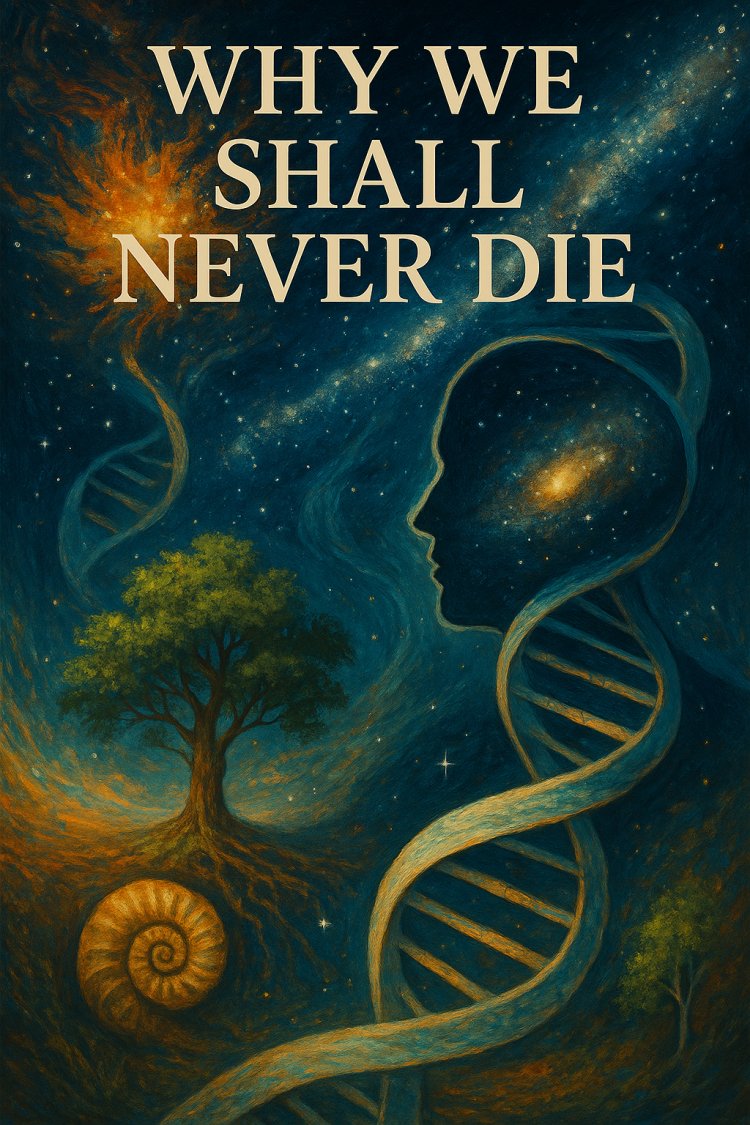
Carl Sagan once said that we are made of star stuff. Neil deGrasse Tyson reminded us that the atoms in our bodies were forged in the hearts of stars that died so we could live. I believe this truth goes even deeper. We are not only made of stars, we are their continuation in conscious form. The cosmos once burned, and now it dreams through us. The stars perished, but their essence did not. It transformed into thought, pulse, and song. This is why we shall never die. We are not visitors in the universe; we are its memory made flesh.
Science has revealed an astonishing unity across all life. Humans share about 60 percent of their DNA with bananas, 84 percent with dogs, 98.8 percent with chimpanzees, nearly 90 percent with cats, and around 50 percent with trees. Even yeast, the single-celled organism that makes bread rise, shares about 31 percent of our genetic code. A cow shares roughly 80 percent, a mouse about 85 percent and a fruit fly nearly 60 percent. With bacteria, we share around 7 percent. Even snakes, those ancient slitherers of the Earth, share nearly 70 percent of our DNA. Perhaps that explains why some people behave like snakes too. These are not coincidences but continuities. Life diversified but the script remained. DNA is the unbroken thread that binds every organism that has ever lived. It is the sacred text of survival, rewritten endlessly by time yet never erased.
Beneath our feet lies a living archive of our ancestry. The soil holds microbes that helped shape the young Earth more than three billion years ago, and many still thrive today. Viruses and bacteria, older than all complex life, continue to sculpt our evolution by editing our genes. Fragments of ancient viral DNA sleep within our chromosomes, remnants of infections that turned into inheritance. Humanity itself is a mosaic of countless ancestors, species and molecular memories. In that sense we are not purely human, we are the living summary of Earth’s entire biological past.
Yet even this vast experiment in life is fragile. Science estimates that 99 percent of all species that ever lived are now extinct. The dinosaurs once ruled for more than one hundred and sixty million years, but even they fell silent. Their legacy endures in birds and in the calcium of our bones. Our own species will one day join that procession. In roughly seven point eight million years humanity too will vanish, undone by the same cosmic forces that birthed us. But this is not the end. The DNA that defines us will not disappear. It will be rearranged, recombined and reborn in new forms. Life will sing again though the voices may differ.
We are made mostly of water, about 60 percent of our bodies by mass, and that water is far older than the Sun. The hydrogen it contains was born in the Big Bang more than thirteen billion years ago. Each sip, each tear and each drop of blood carries the story of creation itself. When we die, that water will return to the clouds, rivers and soil, joining other organisms to begin again. The breath we exhale today may one day fill the lungs of another being or rise into the leaves of a distant tree. This is not metaphor but matter. Nothing is lost. Everything transforms.
Supernovae scattered heavy elements across the galaxy, creating the foundation for planets, oceans and life. The iron in our blood was forged in a dying star. The calcium in our bones once glowed within a celestial giant. The oxygen we breathe was sculpted by stellar fusion across eons. Scientists estimate that about 93 percent of the atoms in the human body come directly from ancient stardust. That is not poetry; it is chemistry. We are the children of supernovae, fragments of fire now walking and wondering beneath the stars that gave us birth.
Life’s unity is not only chemical but also informational. DNA is the universal language of existence, written in four letters that every organism can read. Whether in a fungus clinging to a rock, a coral deep in the ocean, or a bird soaring above the forest, the same alphabet spells the code of being. In a single human cell lie three billion base pairs, and more than half of that sequence is shared with other living forms. When we look at a banana or a dog, we are not seeing a difference but variation, a reflection of the same pattern that pulses within us.
This realization reshapes our understanding of death. Life does not end; it rearranges. The molecules that make us human will one day return to soil, be absorbed by roots, and become nourishment for new lives. Our descendants may look nothing like us, but they will carry fragments of our essence. Even when humanity disappears, the principles of life, self-replication, adaptation, and memory, will continue somewhere, perhaps on another world warmed by another sun.
I once wrote that extinction is not the conclusion but the rewriting of the cosmic story. Every death is the beginning of another sentence in the same universal text. Tyson said the universe is within us. Sagan said we are a way for the cosmos to know itself. I add that the universe does not simply dwell within us; it remembers itself through us.
Five billion years from now, the Sun will swell into a red giant, consuming the inner planets. Earth will burn, and all traces of our civilization will fade. But the atoms and genetic blueprints we leave behind may already have traveled across space, carried by meteors or cosmic dust. Somewhere, far away, a seed of life might awaken, bearing the same molecular echoes that once sang here. In that moment, humanity will rise again, not as it was, but as the next verse in the poem of the cosmos.
The story of existence is a rhythm without end. Water becomes vapor, vapor becomes rain, rain becomes river, river becomes ocean, and from the ocean comes life anew. The same dance governs atoms, memory, and DNA. The ashes of forgotten stars became our bones, and we, in turn, will become the substance of future worlds. In that cycle, death loses its power. It becomes renewal.
We are, as Sagan said, the cosmos made conscious. When humanity ends, consciousness will not vanish but reappear elsewhere, shaped by the same creative forces that formed us. The light that once burned in the hearts of supernovae still burns in our hearts today, and when we return to the dust from which we came, that light will find new forms.
The body may perish. The species may fade. But the pattern remains. The water in our veins will rise again as mist. The carbon in our cells will nourish the earth. The DNA within us will recompose itself into other beings. The fire that once lived in the stars will continue to burn, not in the sky but in the pulse of all that lives.
And that is why we shall never die.
By Fwamba NC Fwamba
What's Your Reaction?