Human Rights, Civilisation and Power :The Cyrus Cylinder Question.
Iran’s Embassy in South Africa has hit back at US Defence Secretary Pete Hegseth’s “Back to the Stone Age” threat by invoking ancient Persia’s Cyrus Cylinder — one of the world’s earliest human rights declarations. The sharp exchange on X contrasts modern military rhetoric with Iran’s historical endurance through Alexander the Great and Mongol invasions. A deep look at civilisation, power, and identity.
By Fwamba NC Fwamba
There has been a sharp exchange between Pete Hegseth and the Iranian Embassy in South Africa on X, following a post in which Hegseth used the phrase “Back to the Stone Age.” The remark relied on the language of overwhelming force, implying the ability to reduce a society to total destruction. The response from Iran reframed the exchange by invoking history, identity, and civilisation. It asked a direct and pointed question in essence: what defines civilisation—power, or endurance?
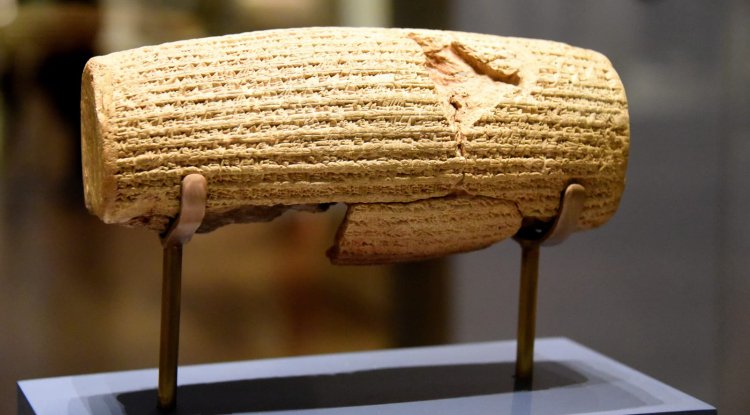
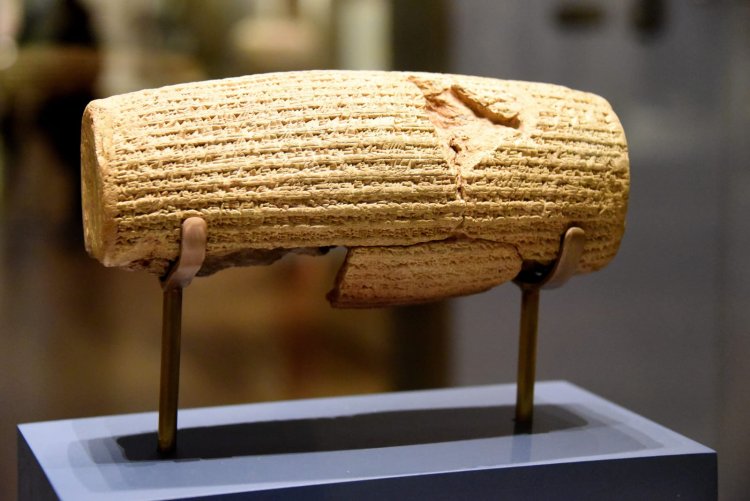
The Iranian response challenged the premise of the insult by contrasting modern military language with ancient political and ethical traditions. It referenced a time “when you were still in caves searching for fire,” and positioned Persia as a civilisation already articulating governance principles through the Cyrus Cylinder. The reference is not casual. It draws on one of the oldest known inscriptions associated with statecraft, dated to 539 BCE, during the reign of Cyrus the Great, after his conquest of Babylon.
The cylinder was created in Babylon using Akkadian cuneiform and placed within the city walls as a foundation deposit. This practice was common in Mesopotamia, where rulers inscribed their achievements in durable form to communicate legitimacy and authority to future generations. In this sense, the cylinder is both a historical record and a political instrument. It presents Cyrus as a ruler who restored order after the fall of Nabonidus, and frames his governance as aligned with divine will.
At the core of the cylinder is a narrative of restoration. It describes the rebuilding of temples, the respect of local traditions, and the return of displaced peoples. These elements have led many modern scholars to interpret the text as an early articulation of ideas associated with human rights. These include religious tolerance, cultural respect, and the right of return. While the cylinder is not a human rights charter in the modern legal sense, it reflects a political philosophy where authority is linked to justice and stability rather than conquest alone.
The Iranian statement draws strength from this interpretation. It presents the cylinder as evidence that ideas resembling human rights existed in ancient Persia long before modern political systems. This raises a deeper question: if principles of governance existed in early forms thousands of years ago, how should they be understood in relation to modern declarations of rights?
The response also invokes historical endurance. It refers to survival through the conquest of Alexander the Great, whose campaigns around 330 BCE ended the Achaemenid Empire but did not erase Persian identity. Persian culture adapted and continued under successive regimes, preserving language, literature, and administrative traditions.
It also references the invasions led by Mongolian warlord Genghis Khan, beginning in the early 13th century CE, around 1206, which brought widespread destruction across Asia and the Middle East. Despite such disruptions, Persian civilisation persisted, evolving while maintaining continuity. This endurance forms a central part of Iran’s argument that civilisation is not defined solely by political power, but by the ability to survive and retain identity across time.
The journey of the Cyrus Cylinder also adds a modern dimension to the discussion. It was discovered in 1879 CE by Hormuzd Rassam during excavations in Babylon, and later taken to the British Museum, where it is preserved today. Its relocation reflects a broader history of archaeology in which artifacts were moved across continents, raising ongoing debates about cultural heritage and ownership.
This leads to another central question: where does historical legitimacy reside—in an object preserved far from its place of origin, or in the civilisation that created and sustained its meaning?
The exchange between Hegseth and Iran is therefore more than a disagreement on social media. It is a confrontation between two ways of defining strength. One speaks the language of force and destruction. The other speaks through history, memory, and continuity.
At its philosophical core, the argument becomes a question of time and identity.
Is civilisation defined by the ability to dominate in the present, or by the capacity to endure across centuries while shaping ideas that continue to influence the world?
The Cyrus Cylinder remains at the centre of this debate as both a historical object and a symbol. It anchors a narrative that connects ancient governance with modern discussions on human rights, and challenges the boundaries of historical interpretation. In doing so, it transforms a modern political exchange into a broader reflection on the meaning of civilisation itself.
What's Your Reaction?